


Since the dawn of time, wood has been a part of our daily lives in our buildings and homes. Along with stone, it was the first material to allow humans to build and furnish dwellings.
Is building with wood an obvious and self-evident choice?

While wood may seem simple and obvious in its use, it's also important to know that it's a natural, not inert, material that will change over time. It will eventually deteriorate when used outdoors and exposed to the elements.
Why will a wooden structure evolve?
The wood was alive before it was cut and retains all its components once transformed.
These factors will evolve and lead to its degradation over the years if left unattended. It is therefore essential to understand them thoroughly to ensure proper implementation and long-term sustainability.
Will the very nature of the wood therefore influence the evolution of the structure over time?
Indeed, the type of wood used, the exposure of the structure and its geographical area will be determining factors in the longevity of the structure, alongside the installation conditions, protection and maintenance provided.
But wood is still wood, and as long as it's finished, everything will be fine?
Absolutely not. Depending on the type of wood chosen, the starting point is not the same. There are hardwoods, softwoods, but also hard and dense exotic woods. Each of them, like the skin on our face, requires appropriate protection.
Will the type of wood used therefore have an impact on the structure?
Indeed, some woods are soft and porous and require a light, filling finish. Others, harder and denser, such as exotic woods or certain hardwoods, need a very penetrating protective coating.
Is there a type of finish that you, as a manufacturer, recommend?
There are several types of protective treatments to suit different needs. Saturators are often the best option for ensuring the longevity of wooden structures.
Thanks to their impregnating qualities, they penetrate the wood, nourishing and protecting it from within. They do not leave a surface film, thus preventing the risk of peeling.
With the increasing demand for wood, are we seeing a change in the types of wood used?
Faced with increasing demand, resources cannot always meet the expected volumes. Alongside this pressure on demand, as professionals, we have seen several problems emerge on our construction sites, all with a common denominator: wood that is too young or has grown too quickly, leading to issues with tannins, density, and/or excess natural oils, particularly with certain exotic woods. These phenomena also affect the longevity of the wood and its protective coatings.
What happens to an exotic wood that has grown too fast?
When exotic wood grows too quickly, its internal structure is altered. It becomes less dense, less hard, and often more porous. It then becomes more susceptible than usual to warping and weathering. The choice of protective treatment will need to be adapted to compensate for these changes.
Are architects, craftsmen, and DIY enthusiasts aware of these developments in the maturity and quality of the woods offered?
Often, when choosing their wood, end users are unaware of the risk of dealing with an exotic wood that was cut too early and select their finish solely based on the species. This is where the problems arise, because a finish designed for exotic woods is intended for hardwoods and will not protect an exotic species in the same way, as it has not benefited from optimal growing conditions and is therefore more porous.
What is the main risk?
Saturators do not work the same way with all wood species: optimal protection depends on the maturity and quality of the wood. If the wood does not meet the product's specifications, the product will not function optimally, and durability will be reduced because the expected protection will not be achieved. It is therefore essential to ensure the quality of the exotic woods chosen. When it becomes clear that the chosen protection is unsuitable, it is important to take action as soon as possible during initial maintenance to ensure the material's longevity.
And what are the consequences of cutting down trees too early?
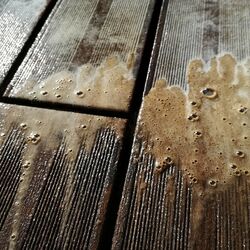
Wood cut too soon hasn't had time to eliminate its secretions. During saturation, stains can appear, creating unsightly effects. For example, an exotic wood saturated with red oils will become even redder after a saturation phase.
The problem is not limited to exotic woods. Hardwoods like oak or chestnut that haven't had time to mature properly will also struggle, with tannins often appearing very dark.
How can these phenomena be explained?
After being cut, wood needs time to release its tannins, oils, and resins. This phase can take several months, and if it is not respected, the secretions will reappear after the application of the saturator, which, by penetrating the wood, causes the mechanical action of drawing them to the surface.
Thus, very young wood contains exudates which always end up leaking out in one way or another, jeopardizing the durability and aesthetics of the applied finish.
It is therefore essential to know the maturity of the wood used for a structure before deciding on its protection.
Too hot, too dry, too fast, less longevity…
We are facing increasingly frequent periods of intense heat; what are the challenges in terms of application?
When applied at too high a temperature, i.e. when the outside temperature and/or that of the substrate is above 30 °C, the main risk lies in the drastic reduction of the longevity of the finish or in its ineffectiveness.
How does heat affect the product?
Excessive heat will cause the molecules in the product to react violently, disintegrate, and become ineffective. The active ingredients in the formula that provide UV protection are particularly fragile and risk losing their function.
Thus, in high temperatures, the effectiveness of a saturator, whether solvent-based or aqueous-phase, is greatly reduced.
How do the side effects associated with excessive application heat manifest themselves?
At excessively high temperatures, the drying and impregnation processes are disrupted. At this point, the finish does not have time to bond with the substrate, nor to penetrate and impregnate properly, and therefore cannot fulfill its protective role.
Sometimes, solvent evaporation can be so intense that the product may simply not really penetrate and remain on the surface forming a film, which is the opposite of the function of a saturator and creates risks of flaking.
It also happens that surface drying is so rapid that it creates a film that blocks transfers between the product and the air and disrupts, or even blocks, its drying.
In terms of longevity, surfaces protected with a finish applied during a heatwave will powder prematurely.
Protecting wood during periods of high heat: can you give us the procedure to follow?
Always factor in drying time in addition to application time before you begin. For best results, application and drying must take place within acceptable temperature ranges.
Start working during the coolest hours, often very early in the morning. And don't forget that a surface at 20°C at 8:00 am can rise by 5 degrees per hour and reach 30°C by noon.
It is essential to take into account the exposure of the surface to be protected, which must not be in direct sunlight during the drying process.
When using a saturating oil, it's essential to work wet-on-wet and in small sections. The chosen application area should allow for the application of the second coat before the first coat dries. Therefore, the warmer the temperature, the smaller the application area should be. Don't hesitate to divide your project into smaller sections to ensure optimal application conditions.
When using a wood stain, it's essential to ensure that the application and initial drying time take place in mild temperatures. Then, adjust the recoating times according to the recommendations on the technical data sheet, taking into account the weather conditions, and don't hesitate to extend them by a few hours if necessary.
Opinion piece by David Veyrat, Technical Service and Formulation Engineer, Durieu Group ( LinkedIn ).
Selection of products

To read also
-
 Business transfer in the construction industry: value is built years in advance
-
 Insurance outlook for companies in the construction and public works sector
-
 Heatwaves: what summer 2026 needs to change in HVAC maintenance
-
 Real Estate: Why 2027 could mark the definitive acceleration of the digital transformation of professionals
-
 Rainwater, wasted energy: the paradox of photovoltaic canopies
-
 Anticipating and preparing for the heat, protecting homes, outsmarting the sun's rays, insulating with innovative solutions, and restoring a healthy indoor environment
-
 Energy efficiency: a challenge in both summer and winter
-
 Back to university: rethinking campus security for student quality of life
Popular News
-
 Building permits: slight decline in August, construction starts are rising again
-
 Urban greening: 61% of French people want more nature in public spaces
-
 At Batimat, Attal, Le Pen and Mélenchon confront the housing crisis
-
 Presidential election 2027: the social housing movement wants to put housing back at the heart of the debate


